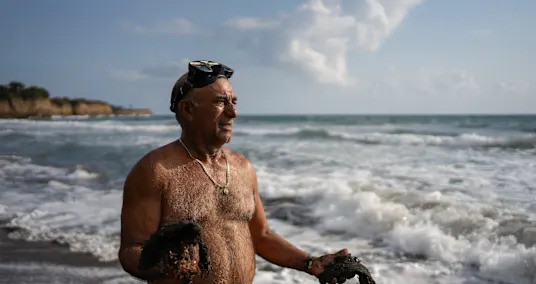
MEXICO CITY (AP) — An oil spill in the Gulf of Mexico in early March spread more than 600 kilometers (373 miles), including to seven nature reserves, and originated from a vessel yet to be identified and two “natural seepages,” Mexican authorities announced Thursday.
Authorities, however, ruled out the possibility of severe environmental damage from the spill off coast of the eastern state of Veracruz.
The release of the preliminary findings came after weeks of controversy surrounding the lack of transparency in the case.
Navy secretary, Admiral Raymundo Morales, said satellite image analysis and inspections of the area identified three sources of the spill: a vessel anchored off the coast of the port city of Coatzacoalcos, in the eastern state of Veracruz; a geological site where crude oil naturally seeps, known as a “chapopotera,” located 8 kilometers (5 miles) from that port; and another natural seepage located in the Bay of Campeche.
Morales said at a press conference that the vessel has not yet been identified because, as of early March, there were 13 ships sailing in the area that had not yet been inspected.
He also admitted that the source of the spill “remains active,” and that one of the main sources is estimated to be the “natural seeps in Cantarell, in the Bay of Campeche.”
“These oil seeps have a constant, natural emission; however, there has been a greater flow of contaminants in the last month,” he said.
Five months earlier, heavy rains and flooding caused a pipeline rupture and a spill, also in Veracruz, that extended for 8 kilometers (5 miles) along the Pantepec River.
In the March spill, Morales reported that the oil covered an area of about 600 kilometers (373 miles) including 200 kilometers (125 miles) of coastline in the southern states of Veracruz and Tabasco. To date, “430 tons of hydrocarbons” have been collected.
Secretary of the Environment Alicia Bárcena reported that the spill affected seven protected natural reserves in the states of Veracruz and Tabasco, but insisted that “we have not detected severe environmental damage.”
Environmental authorities have identified six species, including sea turtles, birds and fish, that were contaminated by the spill.
The National Commission of Natural Protected Areas (Conanp) reported Wednesday in a statement that hydrocarbons have been collected in the Los Tuxtlas Biosphere Reserve, the Veracruz Reef System National Park, the Lechuguillas Sanctuary, the Totonacapan Beaches Sanctuary, the Lobos Tuxpan Reef System Flora and Fauna Protection Area, and south of the Rancho Nuevo Beach Sanctuary in the state of Veracruz. Cleanup efforts were also carried out in the Centla Wetlands Biosphere Reserve in the state of Tabasco.
The international organization Oceana, dedicated to ocean conservation, said this week in a statement that, according to reports from communities belonging to the Gulf of Mexico Reef Corridor Network, the spill killed sea turtles, a manatee and various fish species, and damaged 17 reefs.
___
Follow AP’s Latin America coverage at https://apnews.com/hub/latin-america
LATEST POSTS
- 1
 Air superiority and long-range strikes: what China's war games say about how it might assault Taiwan
 - 2Climate change is straining Alaska's Arctic. A new mining road may push the region past the brink
- 3Manual for Notorious Fragrances: Immortal Aromas
- 4Poland Crypto Bill Clears Sejm Again, Defying President — Will “Restrictive” Rules Stick?
- 5The pace of hiring just fell to the lowest since 2011, outside of the pandemic





- Instructions to Perceive and Grasp the Early Side effects of Cellular breakdown in the lungs
- Vote in favor of Your Fantasy Vehicle: Which Notable Model Catches Your Heart?
- Keep It Cool: Uncovering Famous Fridge Brands for Each Home
- Figure out How to Pick a Crematorium: Key Contemplations.
- 8 Espresso Bean Starting points All over the Planet
- Native artists in Texas and Mexico shared their vision of the universe for 4,000 years, ancient murals suggest
- Bird flu poses risk of pandemic worse than COVID, France's Institut Pasteur says
- Two Passover initiatives target isolation and safety for Israel’s elderly
- Gen Z workplace stereotypes were TV’s favorite punchline in 2025